
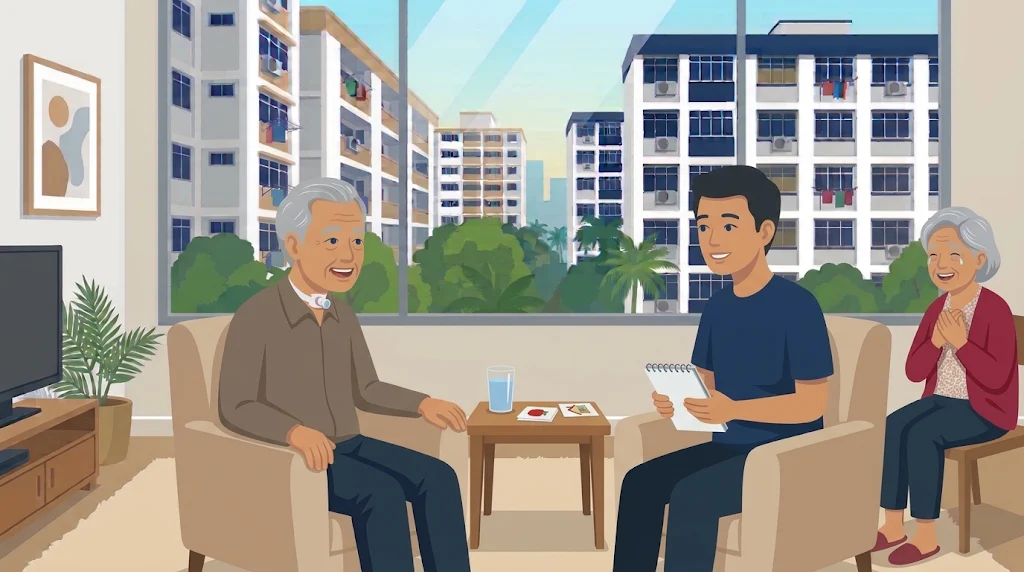
In short: A tracheostomy can affect both talking and eating. We help adults with a tracheostomy communicate, use their voice again where possible, and swallow more safely. We work closely with their doctors and care team, at home, in nursing homes and in other care facilities.
A tracheostomy is a small opening in the front of the neck with a tube placed into the windpipe to help with breathing. With the tube in place, air may no longer pass through the voice box, so the person may be unable to speak. Swallowing can also become harder and less safe. Speech and swallowing therapy aims to restore communication and safe eating, step by step and together with the medical team.
How we can help
- Speaking valve assessment and trials. A one-way speaking valve (for example, a Passy-Muir valve) lets air flow back through the voice box so the person can speak. We check whether it is suitable and build up wearing time safely.
- Cuff deflation trials, with the approval of the medical team.
- Swallowing assessment with a tracheostomy in place, including an instrumental examination (FEES) where suitable.
- Communication support while the voice is not yet available, such as alphabet boards, writing and simple gestures.
- Working towards decannulation (removal of the tube), together with the doctors.
- Training for families, carers and nursing staff on safe eating and drinking, signs that food or drink may be going down the wrong way, and speaking valve care.
Who this is for
Adults with a tracheostomy after a stroke, brain injury, head and neck cancer, a long stay in intensive care, or a progressive neurological condition. We see patients at home across Singapore and in nursing homes and care facilities.
Common questions
Can someone with a tracheostomy speak?
Often, yes. Many people can speak with a speaking valve or when the cuff is deflated, if their medical team agrees it is safe.
Can someone with a tracheostomy eat and drink?
Some people can, depending on their swallowing and breathing. A swallowing assessment shows what is safe, and the plan is agreed with the medical team.
Do you work with the patient’s doctors?
Yes. Decisions about the tube, the cuff and the speaking valve are made together with the doctors and care team. With consent, we keep them updated.
Can therapy be done at home?
Yes. We see patients with a tracheostomy at home across Singapore, as well as in nursing homes and care facilities.