Category: CTAR Exercise

Chin Tuck Against Resistance (CTAR): exercise videos and handouts in 7 languages, research and news.

  • Chin Tuck Against Resistance (CTAR): A Guide from the Originator

    Chin Tuck Against Resistance (CTAR): A Guide from the Originator

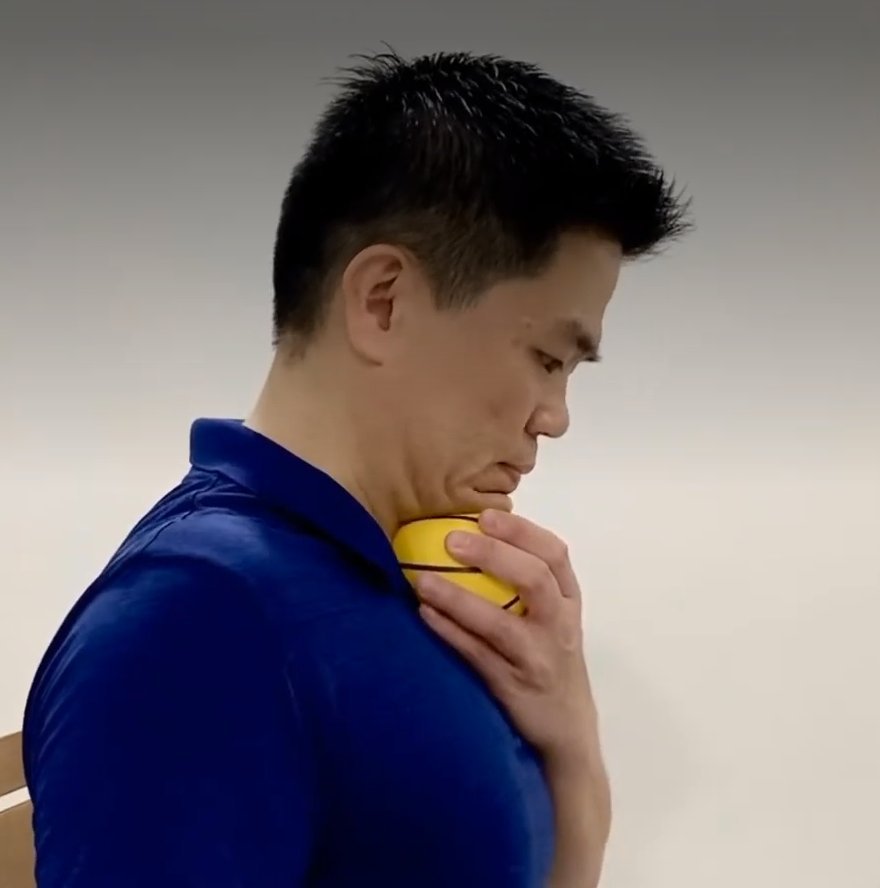
    In short: Chin Tuck Against Resistance (CTAR) is a swallowing exercise that strengthens the suprahyoid muscles, the muscles under the chin that pull the hyoid bone up and forward during swallowing, which helps open the upper oesophageal sphincter so food and drink can pass into the food pipe. It is done sitting or standing, by tucking the chin down firmly against a small rubber ball. CTAR was developed by Singapore speech therapist Yoon Wai Lam and first published in the journal Dysphagia in 2014.

    Why CTAR was developed

    For many years, the Shaker (head-lift) exercise was the standard way to strengthen the suprahyoid muscles. It requires lying flat on the back and repeatedly lifting the head, which many people find tiring and hard on the neck. It is especially difficult for older adults, people who are frail or bedbound, and those who cannot lie flat.

    CTAR was designed to train the same muscles in an upright position, using a simple rubber ball for resistance. This makes it practical to do at home, in a chair or at the bedside, with very little equipment.

    How to do CTAR

    You will need: a rubber ball about 12 cm in diameter for most adults. The right size depends on the length of your neck, so your speech therapist will advise. A ball pump can be used to adjust the firmness.

    Part 1: Sustained CTAR (isometric)

    1. Sit or stand upright with your shoulders back. Keep this posture throughout.
    2. Hold the ball under your chin with one hand.
    3. Tuck your chin down against the ball as hard as you can, and hold for 60 seconds.
    4. Rest for 1 minute.
    5. Repeat for a total of 3 sets, twice a day.

    Part 2: Repetitive CTAR (isokinetic)

    1. Keep the same upright posture, with the ball under your chin.
    2. Tuck your chin down hard against the ball, then lift your chin.
    3. Repeat 60 times, or as recommended by your speech therapist. Rest briefly if you need to.
    CTAR with a rubber ball, demonstrated by its originator. Also available in Mandarin, Malay, Korean, Japanese, Taiwanese Minnan and Bengali.

    What the research shows

    • 2014, the original study (Yoon, Khoo & Rickard Liow, Dysphagia): In 40 healthy adults, surface EMG showed that CTAR activated the suprahyoid muscles significantly more than the Shaker exercise during the sustained (isometric) task, and at least as much during the repetitive (isokinetic) task. The study won First Place for Scientific Abstract at the 21st Annual Meeting of the Dysphagia Research Society, Seattle (2013).
    • 2016, training effects (Sze, Yoon, Escoffier & Rickard Liow, Dysphagia): compared the training effects of CTAR and the Shaker exercise using surface EMG. In 39 healthy adults, CTAR targeted the suprahyoid muscles more specifically than the Shaker exercise and fatigued them equally or more, while the sternocleidomastoid (a large neck muscle) was significantly less activated and less fatigued. In other words, CTAR works the swallowing muscles hard while putting less strain on the neck.
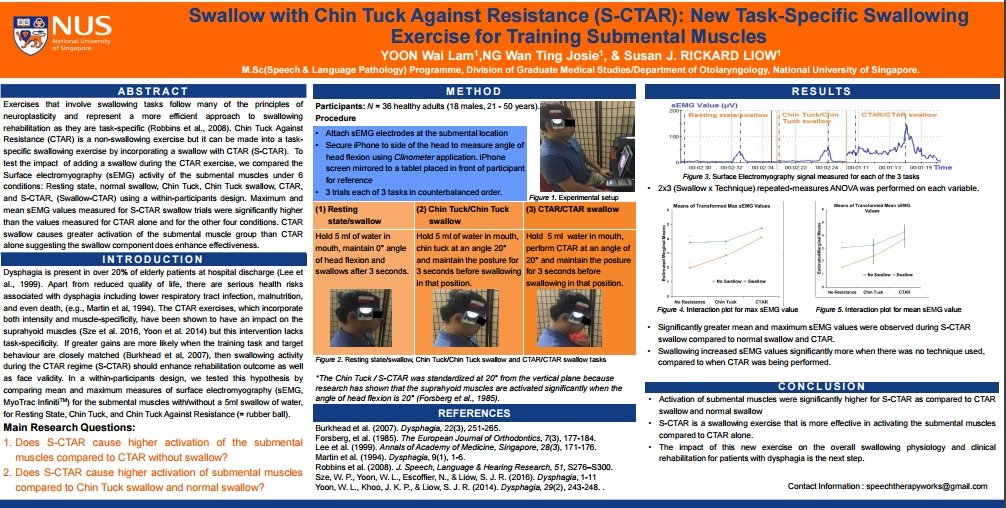
    • 2017, Swallow with CTAR (S-CTAR): combines a swallow with CTAR to make the exercise more task-specific to swallowing (Dysphagia Research Society, Portland).
    • CTAR has since been studied and used by clinicians and researchers in many countries.

    Who CTAR can help

    After a swallowing assessment, CTAR may be included in therapy for adults with weak swallowing muscles, for example:

    Safety: do it with professional guidance

    CTAR should be prescribed after a proper swallowing assessment by a speech therapist, who will check that it suits your condition and set the right ball size, effort and number of repetitions. Stop and seek advice if you feel neck pain, dizziness or discomfort. If you have neck or spine problems, check with your doctor or therapist first. Exercises like CTAR are one part of swallowing therapy and do not replace advice on safe food and drink textures.

    Frequently asked questions

    What is the difference between CTAR and the Shaker exercise?

    Both strengthen the suprahyoid muscles. The Shaker exercise is done lying flat and lifting the head, while CTAR is done sitting or standing by tucking the chin against a ball. Many people find CTAR easier to do and less tiring for the neck.

    How often should I do CTAR?

    A common programme is a 60-second hold repeated 3 times, plus 60 repetitive chin tucks, twice a day. Your speech therapist may adjust this to suit you.

    What size ball should I use?

    About 12 cm in diameter suits most adults, but the best size depends on the length of your neck. Your therapist will check the fit.

    Can I do CTAR without seeing a speech therapist?

    It is best to have a swallowing assessment first. Swallowing difficulties have many causes, and a therapist can tell you whether CTAR is right for you and how to do it safely.

    Where can I find a CTAR video in my language?

    The video above is also available in Mandarin, Malay, Korean, Japanese, Taiwanese Minnan and Bengali.

    References

    • Yoon, W.L., Khoo, J.K.P., & Rickard Liow, S.J. (2014). Chin Tuck Against Resistance (CTAR): New method for enhancing suprahyoid muscle activity using a Shaker-type exercise. Dysphagia, 29(2), 243–248. doi:10.1007/s00455-013-9502-9
    • Sze, W.P., Yoon, W.L., Escoffier, N., & Rickard Liow, S.J. (2016). Evaluating the training effects of two swallowing rehabilitation therapies using surface electromyography: Chin Tuck Against Resistance (CTAR) exercise and the Shaker exercise. Dysphagia, 31(2), 195–205. doi:10.1007/s00455-015-9678-2
    • Yoon, W.L., Ng, W.T., & Rickard Liow, S. (2017). Swallow with Chin Tuck Against Resistance (S-CTAR): New task-specific swallowing exercise for training submental muscles. Poster, 25th Annual Meeting of the Dysphagia Research Society, Portland, USA.

    Written by Yoon Wai Lam, originator of CTAR, Director and Senior Principal Speech Therapist, B.Speech Sc. (Hons), in clinical practice since 2001. This article is for general information and does not replace an individual assessment. Contact us to arrange a swallowing assessment.
  • CTAR Recognised in the Evolution of Swallowing Rehabilitation

    CTAR Recognised in the Evolution of Swallowing Rehabilitation

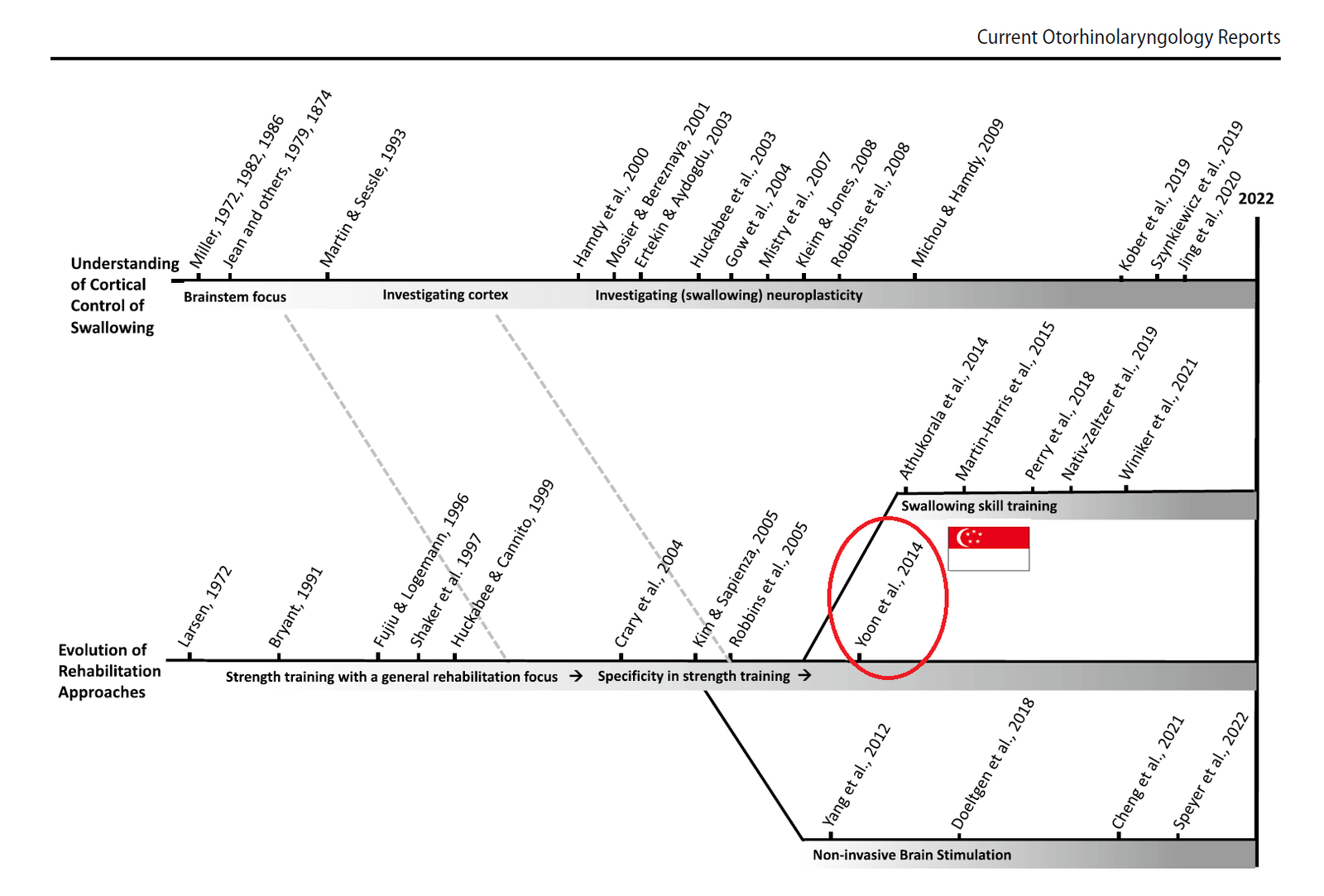
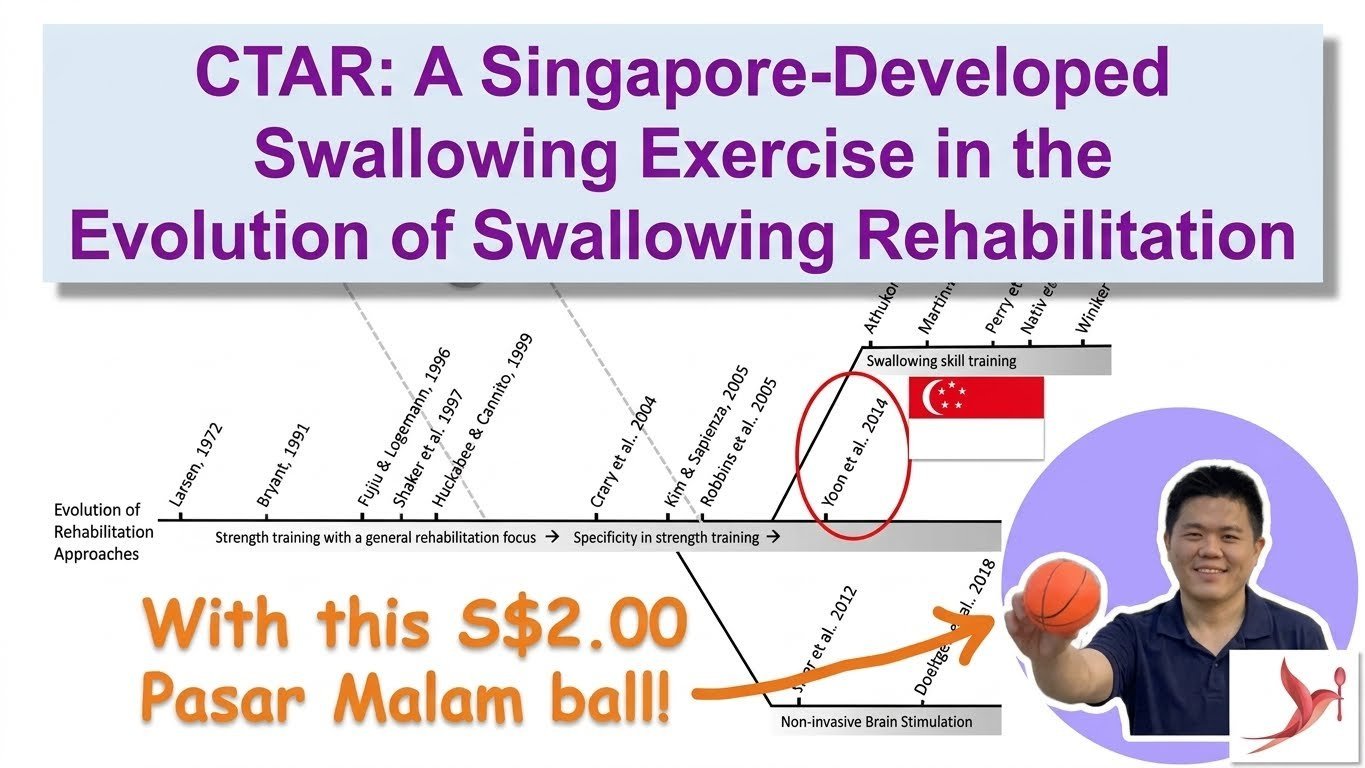
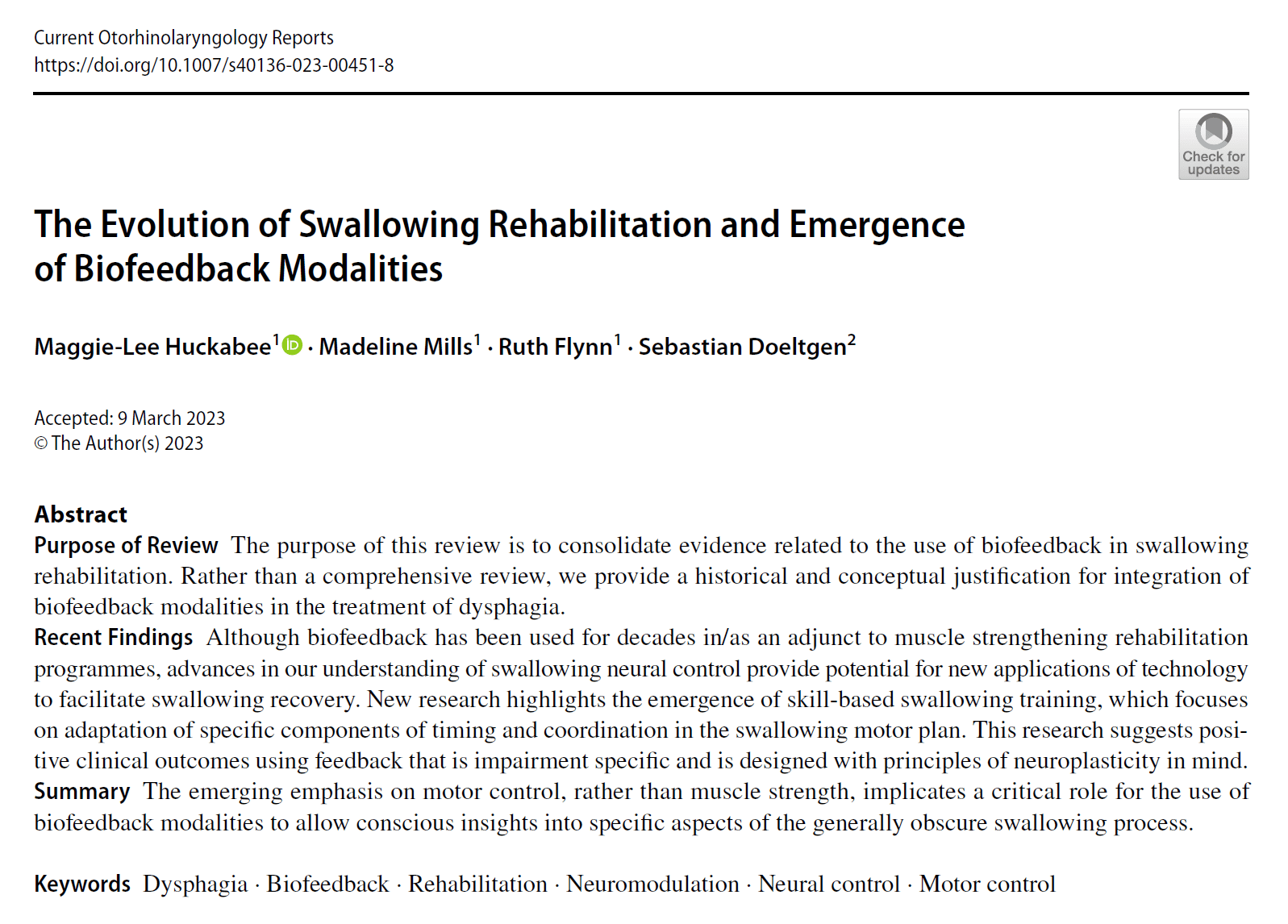
    In 2023, a review of how swallowing rehabilitation has evolved (Huckabee et al., 2023) recognised CTAR (Chin Tuck Against Resistance) as one of the exercises that has shaped the field. CTAR was developed in Singapore by speech therapist Yoon Wai Lam as a simple, low-cost way to strengthen the suprahyoid muscles used in swallowing. The very first version used an S$2 inflatable rubber ball bought at a pasar malam (night market).

    Figure taken from:
    Huckabee, ML., Mills, M., Flynn, R. et al. The Evolution of Swallowing Rehabilitation and Emergence of Biofeedback Modalities. Curr Otorhinolaryngol Rep 11, 144–153 (2023). https://doi.org/10.1007/s40136-023-00451-8

    CTAR was first presented internationally at the Dysphagia Research Society meeting in Seattle, USA, in 2013. It drew strong interest and won first place for Scientific Abstract Poster. The first CTAR paper, published in the journal Dysphagia in 2014, was one of the journal’s top 10 most downloaded articles that year, and a follow-up study in 2016 added further evidence. Together, the two papers have been cited more than 220 times in journal articles and textbooks (Springer, November 2026).

    CTAR has since inspired a number of commercial devices around the world. Mr Yoon’s own approach remains low-cost: the exercise can be done with a simple rubber ball, or with the hand providing the resistance, with no special equipment needed.

    To make CTAR freely available, Mr Yoon set up the Singapore Swallowing Specialists YouTube channel. It offers CTAR videos in seven languages, which have been viewed more than 150,000 times worldwide (October 2026).

    Find out more:

    References:

    • Huckabee, ML., Mills, M., Flynn, R. et al. The Evolution of Swallowing Rehabilitation and Emergence of Biofeedback Modalities. Curr Otorhinolaryngol Rep 11, 144–153 (2023). https://doi.org/10.1007/s40136-023-00451-8
    • Sze, W. P., Yoon, W. L., Escoffier, N., & Rickard Liow, S. J. (2016). Evaluating the Training Effects of Two Swallowing Rehabilitation Therapies Using Surface Electromyography-Chin Tuck Against Resistance (CTAR) Exercise and the Shaker Exercise. Dysphagia, 31(2), 195–205. http://doi.org/10.1007/s00455-015-9678-2
    • Yoon, W.L., Khoo, J., & Liow, S. (2014). Chin tuck against resistance (CTAR): a new method for enhancing suprahyoid muscle activity using a Shaker-type exercise. Dysphagia. Retrieved from http://link.springer.com/article/10.1007/s00455-013-9502-9
  • (Mandarin) Dysphagia Swallowing Therapy – Chin Tuck Against Resistance with Rubber Ball.吞咽障碍复健运动 – 缩下巴抗阻运动 (CTAR) 创始者示范运用橡皮球做练习

    Youtube Video on CTAR in Mandarin
    GDM would like to thank Mr Eng Tze Hao (Speech Therapist from Singapore) for his help in translation and presentation of the Mandarin Version of the CTAR video.

    The following Mandarin CTAR video and blog post are initiative of the Global Dysphagia Movement (GDM).
    缩下巴抗阻运动能训练你的上舌骨肌群,以打开进食通道(上食道括约肌),让食物顺利的进入胃。


    The Chin Tuck Against Resistance (CTAR) exercise works on strengthening the suprahyoid muscles, necessary for opening your upper food pipe sphincter (or known as the upper esophageal sphincter) to allow food to enter the stomach. 
    这个运动从袁伟琳先生于2013年创始后,就在国际间广为使用,我们希望这支影片可以提供更多执行运动的细节。我们计划将这只影片以及未来更多的影片翻成不同语言,提供世界各地使用。


    Since CTAR was introduced in 2013, Mr Yoon (The CTAR inventor) has been receiving enquiries from clinicians from around the world. We hope that this video will provide the details to facilitate the carrying out of the exercise. There are plans to translate this video into different languages, so as to allow different people around the world to gain an understanding about the exercise and its proper usage.
    如果你喜欢这个影片,请不吝按赞,同时记得分享及订阅我们的频道,以收看更多关于CTAR和吞咽的影片。 想知道更多吞咽困难处置的有用资讯和方法,请追踪我们的部落格https://yoonspeechswallow.sg/resources/


    Please LIKE, SHARE and SUBSCRIBE to our channel for more upcoming CTAR series and swallowing exercises tips in different languages. Follow us at our blog at https://yoonspeechswallow.sg/resources/ for more useful information and tips on dysphagia management.
    下载CTAR运动指导的PDF,请点击下方的连结: (To download a PDF copy of the CTAR exercise instructions):

    * Click to view CTAR videos in the following languages.

    ** Chin Tuck Against Resistance or CTAR is suitable for:

    • dysphagia or swallowing difficulties following strokes,
    • dysphagia following head and neck cancer,
    • dysphagia following Parkinson’s disease,
    • dysphagia due to late effect of radiotherapy e.g. nasopharyngeal cancer
    • etc.
  • (Korean) Dysphagia Swallowing Therapy – Chin Tuck Against Resistance with Rubber Ball. 삼킴 장애 요법 – 고무공 사용하는 저항성 턱 당기기 (한국어)

    GDM would like to thank Ms Sandy Lim (SLP from USA) for her help in translation and presentation of the Korean Version of the CTAR video.

    This Korean translated CTAR video and blog post are initiative of the Global Dysphagia Movement (GDM).

    The Chin Tuck Against Resistance (CTAR) exercise works on strengthening the suprahyoid muscles, necessary for opening your upper food pipe sphincter (or known as the upper esophageal sphincter) to allow food to enter the stomach.

    저항성 턱 당기기 운동은 목뿔의근을 강화시켜 상부 식도 괄약근을 열어 음식이 위장에 들어갈수있게 해줍니다.

    Since CTAR was introduced in 2013, Mr Yoon (The CTAR inventor) has been receiving enquiries from clinicians from around the world. We hope that this video will provide the details to facilitate the carrying out of the exercise. We plan to translate this and all our upcoming videos into different languages.

    2013년 저항성 턱 당기기 운동이 소개 된 이후 운동 발명가 윤선생님께서는 전 세계에서 문의를 받고 있습니다. 이 동영상이 연습수행을 용이하게 하는데에 도움이 되길를 바랍니다. 이 동영상과 앞으로 나올 모든영상들은 여러 언어로 번역될  예정입니다.

    The following is the CTAR exercise instructions. You may download a PDF copy of these instructions at the bottom of this page.

    다음은 저항성 턱 당기기 운동 지침입니다. 이 페이지 하단에서 이 지침의 PDF사본을 다운로드 할 수 있습니다.

    For clinicians, you may download the above QR code and print it on your exercise handouts to facilitate clients’ search for the above YouTube Video.

    치료사일 경우, 위 QR 코드를 다운로드 받은 후 유인물에 인쇄하면  환자가 위의 YouTube 동영상을 쉽게 검색 할수있습니다.

    저항성 턱 당기기 고무공 사용법

    목적: 삼키는데 사용되는 목뿔위근육을 강화시키기 위함. 상부 식도 괄약근을 열어 음식이 위장에 들어갈수 있도록 하려면 목뿔위근이 중요하다.

    준비물: 1. 고무공  2. 공기 펌프, 공 펌프 니들 밸브 (추가 필요물) – 공의 직경과 압력을 높이기 위해

    설명:

    1부: 지속적인 저항성 턱 당기기 (등척성)

    1. 바로 앉거나 서서 어깨를 뒤로 폅니다. 이 자세를 유지 하십시오.
    2. 손으로 공을턱 아래에 고정시키고 이 자세를 유지하십시오.
    3. 턱을 세게 당겨주세요; _____초 동안 유지하십시오.
    4. 언어 치료사가 권장하는대로 ____세트를 반복하십시오.
    5. 세트 사이 일분동안 휴식을 취하십시오.

    2부: 반복적인 저항성 턱 당기기 (등장성)

    1. 바로 앉거나 서서 어깨를 뒤로 폅니다. 이 자세를 유지 하십시오.
    2. 손으로 공을턱 아래에 고정시키고 이 자세를 유지하십시오.
    3. 턱을 세게 당긴다음 턱을 드세요.
    4. 언어 치료사가 권장한 대로 위의 단계를 ____회 ____세트를 반복하십시오.
    5. 세트 사이 일분동안 휴식을 취하십시오.

    YouTube 동영상을 보시려면

    -다음 링크를 https://youtu.be/CExiSYvpcSo 클릭하면 YouTube 동영상으로 바로 연결됩니다.

    To download a PDF copy of the CTAR exercise instructions, please click on:

    저항성 턱 당기기 운동 지침의 PDF 사본을 다운로드 하시려면 ?? 눌러주십시오.

    CTAR with Rubber Ball Exercise videos are available in the following languages:

    * Click to view CTAR videos in the following languages.

    ** Chin Tuck Against Resistance or CTAR is suitable for:

    • dysphagia or swallowing difficulties following strokes,
    • dysphagia following head and neck cancer,
    • dysphagia following Parkinson’s disease,
    • dysphagia due to late effect of radiotherapy e.g. nasopharyngeal cancer
    • etc.

  • (Taiwanese Minnan) Dysphagia Swallowing Exercise – Chin Tuck Against Resistance with Ball 臺灣閩南語(臺語) 吞嚥障礙復健運動-下巴阻抗運動 CTAR 創始者示範運用橡皮球做練習

    GDM would like to express our heartfelt thanks to the Taiwanese SLP team for their help in translation and presentation of the Taiwanese Minnan Version of the CTAR video.

    This Taiwanese Minnan translated CTAR video and blog post are initiative of the Global Dysphagia Movement (GDM).

    縮下巴阻抗運動能訓練你的上舌骨肌群,以打開進食通道(上食道括約肌),讓食物順利的進入胃。

    The Chin Tuck Against Resistance (CTAR) exercise works on strengthening the suprahyoid muscles, necessary for opening your upper food pipe sphincter (or known as the upper esophageal sphincter) to allow food to enter the stomach. 

    這個運動從袁伟琳先生於2013年創始後,就在國際間廣為使用,我們希望這支影片可以提供更多執行運動的細節。我們計畫將這隻影片以及未來更多的影片翻成不同語言,提供世界各地使用。

    Since CTAR was introduced in 2013, Mr Yoon (The CTAR inventor) has been receiving enquiries from clinicians from around the world. We hope that this video will provide the details to facilitate the carrying out of the exercise. 

    如果你喜歡這個影片,請不吝按讚,同時記得分享及訂閱我們的頻道,以收看更多關於CTAR和吞嚥的影片。 想知道更多吞嚥困難處置的有用資訊和方法,請追蹤我們的部落格https://yoonspeechswallow.sg/resources/

    Please LIKE, SHARE and SUBSCRIBE to our channel for more upcoming CTAR series and swallowing exercises tips in different languages. Follow us at our blog at https://yoonspeechswallow.sg/resources/ for more useful information and tips on dysphagia management.

    下載CTAR運動指導的PDF,請點擊下方的連結: (To download a PDF copy of the CTAR exercise instructions):

    CTAR with Rubber Ball Exercise videos are available in the following languages:

    * Click to view CTAR videos in the following languages.

    Chin Tuck Against Resistance / CTAR is suitable for individuals with:

    • dysphagia or swallowing difficulties following strokes,
    • dysphagia following head and neck cancer,
    • dysphagia following Parkinson’s disease,
    • dysphagia due to late effect of radiotherapy e.g. nasopharyngeal cancer
    • etc.

  • (Japanese) Dysphagia Swallowing Exercise – Chin Tuck Against Resistance with Rubber Ball ゴムボールを使用した顎引き抵抗運動(CTAR) 

    YouTube Video on Japanese CTAR with Rubber Ball
    GDM would like to express our heartfelt thanks to Dr Kotomi Sakai for her help in translation and presentation of the Japanese Version of the CTAR video.

    This Japanese translated CTAR video and blog post are initiative of the Global Dysphagia Movement (GDM).

    The following is the CTAR exercise instructions. You may download a PDF copy of these instructions at the bottom of this page.

    下記にCTARの運動方法が記載してあります。このページの下でそのPDFがダウンロードできます。

    Chin Tuck Against Resistance (CTAR) with a Rubber Ball

    Purpose: To strengthen the suprahyoid muscles used in swallowing. The suprahyoid muscles are important to open your upper food pipe sphincter (upper esophageal sphincter) to allow food to enter your stomach.

    Translation:

    目的:嚥下に使用する舌骨上筋群の筋力を強化するため。舌骨上筋群は食物が胃にはいるように導く道の上部(上部食道入口部)が開くために重要な働きをします。

    Equipment: a)Rubber ball, b)Air pump and ball pump needle valve (optional) – to increase diameter and pressure of the ball

    Translation:

    道具:1)ゴムボール、2)エアポンプとボール用空気注入針(オプション:ボールの大きさや圧を増加させるため)

    Instructions:

    Part 1: Sustained CTAR (Isometric)

    Part 1:持続CTAR(等尺性)

    1. Sit / stand upright and pull your shoulders back. Maintain this posture during the exercise.

    まっすぐに座るか立って、肩を軽く後ろに引きます。この姿勢を運動中は維持するようにします。

    • Hold the ball under your chin with your hand and keep it in position during the exercise.

    ボールを手で持って顎の下ではさんで、この姿勢を運動中は維持します。

    • Sustain chin tuck against the ball as hard as possible; for the duration of _______ sec.

    ボールに向かって可能な限り強く顎を引き続けます。持続時間は_______秒です。

    • Repeat _______ sets as recommended by your speech therapist / pathologist.

    嚥下リハビリテーションの担当者の指示に基づいて_______セットを繰り返しましょう。

    • Rest for 1 minute in between each set of the exercise.

    各セットの間は1分間の休憩をとりましょう。

    Part 2: Repetitive CTAR (Isokinetic)

    Part 2: 反復CTAR(等張性)

    1. Sit / stand upright and pull your shoulders back. Maintain this posture during the exercise.

    まっすぐに座るか立って、肩を軽く後ろに引きます。この姿勢を運動中は維持するようにします。

    • Hold the ball under your chin with your hand and keep it in position during the exercise.

    ボールを手で持って顎の下ではさんで、この姿勢を運動中は維持します。

    • Tuck your chin in, as hard as possible against the ball; then lift your chin.

    ボールに向かって可能な限り強く顎を引いて、そして力を抜きます。

    • Repeat the above steps for ________ times and ________ sets as recommended by your speech therapist / pathologist.

    上記のステップを担当治療者の指示に基づいて________回、________セット繰り返します。

    • Rest for 1 minute in between each set of the exercise.

    各セットの間は1分間の休憩をとるようにします。

    To view the YouTube video, you may

    scan on the following QR code with your mobile device camera access YouTube via https://youtu.be/E0qUYlihHNM

    Translation:

    YouTubeビデオをみるためには

    - QRコードをスキャンして

    - YouTubeサイトhttps://youtu.be/E0qUYlihHNM にアクセスをして下さい

    CTAR with Rubber Ball Exercise videos are available in the following languages:

    * Click to view CTAR videos in the following languages.

    Chin Tuck Against Resistance or CTAR is suitable for:

    • dysphagia or swallowing difficulties following strokes,
    • dysphagia following head and neck cancer,
    • dysphagia following Parkinson’s disease,
    • dysphagia due to late effect of radiotherapy e.g. nasopharyngeal cancer
    • etc.
  • (Bengali) Dysphagia Swallowing Exercise – Chin Tuck Against Resistance with Rubber Ball খাবার গলধকরনজনিত সমস্যার থেরাপি- রাবার বলের মাধ্যমে সি টি এ আর থেরাপি

    GDM would like to thank Mr Abul for his help in translation and presentation of the Bengali Version of the CTAR video.

    This Bengali translated CTAR video and blog post are initiative of the Global Dysphagia Movement (GDM).

    উল্লেখিত সি টি এ আর ব্যায়ামের নির্দেশাবলী আপনি ডাউনলোড করতে হলে পৃষ্ঠার নিচে চলে যেতে হবে । থেরাপিস্টরা কিউ আর কোড ডাউনলোড করতে পারেন এবং প্রিন্ট করে নিতে পারেন যদি আপনার রুগীকে এই ইউটিঊব ভিডিওটি দেখাতে চান ।

    রাবার বলের মাধ্যমে সি টি এ আর থেরাপি

    উদ্দেশ্যঃ

    সুপ্রাহাইওয়েড মাংসপেশির শক্তিবৃদ্ধির জন্য এবং সুপ্রাহাইওয়েড মাংসপেশির শক্তিবৃদ্ধির মাধ্যমে খাদ্যনালির উপরিভাগের মধ্যদিয়ে খাবার পাকস্থলীর মধ্যে যেতে সাহায্য করে

    যন্ত্রপাতিঃ 

    সি টি এ আর এর জন্য জিনিসপত্রঃ  

    রাবারের বল , বল পাম্প দেওয়ার ভাল্ব (ঐচ্ছিক) – হস্তচালিত পাম্প (ঐচ্ছিক); বলের পরিধি কমানো বাড়ানোর জন্য

    নির্দেশাবলীঃ

    অংশ ১ঃ সাস্টেইন সি টি এ আরঃ

    ১। সোজা হয়ে বসা বা দাঁড়ানো অবস্থায় কাঁধটাকে শরীরের পিছনের দিকে তুলে ধরতে হবে এভাবে সঠিক দেহভঙ্গি নিয়ন্ত্রণ করতে হবে

    ২। থুতনির নিচে বলটি  হাত দিয়ে ধরে রাখতে হবে

    ৩। থুতনির নিচে বলটি রাখার পর থেরাপিস্টের পরামর্শ অনুযায়ী থুতনিকে বলের বিপরীতে চাপ দিয়ে ধরে রাখতে হবে ___ সেকেন্ডের জন্য যতটুকু পর্যন্ত শক্তি প্রয়োগ করা যায়

    ৪। থেরাপিস্টের পরামর্শ অনুযায়ী __ বার করতে হবে

    ৫। প্রত্যেকবার ব্যায়াম করার মাঝখানে ১ মিনিট করে বিশ্রাম নিতে হবে

    অংশ ২ঃ রিপিটিটিভ সি টি এ আরঃ

    ১। সোজা হয়ে বসা বা দাঁড়ানো অবস্থায় কাঁধটাকে শরীরের পিছনের দিকে তুলে ধরতে হবে এভাবে সঠিক দেহভঙ্গি নিয়ন্ত্রণ করতে হবে

    ২। থুতনির নিচে বলটি  হাত দিয়ে ধরে রাখতে হবে

    ৩। থুতনির নিচে বলটি রাখার পর থেরাপিস্টের পরামর্শ অনুযায়ী থুতনিকে বলের বিপরীতে চাপ দিয়ে ধরে রাখতে হবে এবং উপরের দিকে থুতনি উঠানো লাগবে

    ৪। রিপিটিটিভ সি টি এ আর এর ক্ষেত্রে কতবার  পুনরাবৃত্তি করতে হবে এবং কতসময়  করতে তা একমাত্র একজন গ্রাজুয়েট স্পিচ অ্যান্ড ল্যাঙ্গুয়েজ থেরাপিস্ট নির্ধারণ করবেন

    ৫। প্রত্যেকবার ব্যায়াম করার মাঝখানে ১ মিনিট করে বিশ্রাম নিতে হবে

    ইউটিউব ভিডিওর জন্য-

    – আপনার ফোনের ক্যামেরা দিয়ে কিউ আর কোড স্ক্যান করুন

    – ইউটিউব লিঙ্ক  https://youtu.be/Z-kmMnjsNd4

    অনুবাদক

    আবুল কাশেম সিহাব

    স্পিচ অ্যান্ড ল্যাঙ্গুয়েজ থেরাপিস্ট

    CTAR with Rubber Ball Exercise videos are available in the following languages:

    * Click to view CTAR videos in the following languages.

    Chin Tuck Against Resistance (CTAR) exercise is suitable for most patients with swallowing difficulties / dysphagia i.e.

    • dysphagia or swallowing difficulties following strokes,
    • dysphagia following head and neck cancer,
    • dysphagia following Parkinson’s disease,
    • dysphagia due to late effect of radiotherapy e.g. nasopharyngeal cancer
    • etc.
  • Latihan Menelan (Dysphagia Therapy) Chin Tuck Against Resistance / CTAR dengan Bola Getah

    Video latihan menelan Chin Tuck Against Resistance / CTAR
    GDM would like to express our heartfelt thanks to Ms Siti Amirah for her help in translation of the Malay Version of the CTAR video.

    Video latihan menelan Chin Tuck Against Resistance / CTAR ini merupakan video Bahasa Melayu pertama yang dihasilkan oleh Singapore Swallowing Specialists.

    Chin Tuck Against Resistance (CTAR) dengan Bola Getah

    Tujuan: Untuk menguatkan otot suprahyoid yang digunakan semasa menelan. Otot-otot suprahyoid penting untuk membuka sfinkter paip makanan atas anda (sfinkter esofagus atas) untuk membolehkan makanan memasuki perut anda.

     Peralatan: 1) Bola getah, 2) jarum pam udara dan pam udara (pilihan) – untuk meningkatkan diameter dan tekanan bola

     Arahan:

     Bahagian 1: CTAR berkekalan (Isometrik)

    • Duduk / berdiri tegak dan tarik bahu ke belakang.  Kekalkan postur ini semasa latihan.
    • Pegang bola di bawah dagu dengan tangan anda dan kekalkan posisi bola sepanjang latihan.
    • Tundukkan dagu anda pada bola sekeras mungkin; dan kekalkan  selama _______ saat.
    • Ulangi _______ set seperti yang disyorkan oleh terapis / patologis pertuturan anda.
    • Rehat selama 1 minit di antara setiap set latihan.

     Bahagian 2: CTAR berulang (Isokinetik)

    • Duduk / berdiri tegak dan tarik bahu ke belakang.  Kekalkan postur ini semasa latihan.
    • Pegang bola di bawah dagu dengan tangan anda dan kekalkan posisi bola sepanjang latihan.
    • Tundukkan dagu anda, sekeras mungkin pada bola;  kemudian angkat dagu.
    • Ulangi langkah di atas untuk ________ kali dan set ________ seperti yang disyorkan oleh terapis / patologis pertuturan anda.
    • Rehat selama 1 minit di antara setiap set latihan.

    Klik pada yang berikut untuk memuat turun (download) arahan latihan:

    CTAR with Rubber Ball Exercise videos are available in the following languages:

    * Click to view CTAR videos in the following languages.

    Chin Tuck Against Resistance (CTAR) exercise is suitable for most patients with swallowing difficulties / dysphagia:

    • dysphagia or swallowing difficulties following strokes,
    • dysphagia following head and neck cancer,
    • dysphagia following Parkinson’s disease,
    • dysphagia due to late effect of radiotherapy e.g. nasopharyngeal cancer
    • etc.
  • Dysphagia Swallowing Therapy – Chin Tuck Against Resistance (CTAR) with Rubber Ball

    Video on CTAR by using the rubber ball

    Singapore Swallowing Specialists (SSS) network has just released their very first swallowing therapy video on Chin Tuck Against Resistance (CTAR) by using the rubber ball (Series 1). We plan to produce more series on CTAR and other swallowing therapy exercises / strategies and translate all the videos to different languages from around the world. SSS hopes to reach out to benefit more people worldwide.

    The following is the CTAR exercise instructions. You may download a PDF copy of these instructions at the bottom of this page.

    For clinicians, you may download the above QR code and print it on your exercise handouts to facilitate clients’ search for the above YouTube Video.

    Chin Tuck Against Resistance (CTAR) with a Rubber Ball

    Purpose: To strengthen the suprahyoid muscles used in swallowing. The suprahyoid muscles are important to open your upper food pipe sphincter (upper esophageal sphincter) to allow food to enter your stomach.

    Equipment: a)Rubber ball, b)Air pump and ball pump needle valve (optional) – to increase diameter and pressure of the ball

    Instructions:

    Part 1: Sustained CTAR (Isometric)

    1. Sit / stand upright and pull your shoulders back. Maintain this posture during the exercise.
    2. Hold the ball under your chin with your hand and keep it in position during the exercise.
    3. Sustain chin tuck against the ball as hard as possible; for the duration of _______ sec.
    4. Repeat _______ sets as recommended by your speech therapist / pathologist.
    5. Rest for 1 minute in between each set of the exercise.

    Part 2: Repetitive CTAR (Isokinetic)

    1. Sit / stand upright and pull your shoulders back. Maintain this posture during the exercise.
    2. Hold the ball under your chin with your hand and keep it in position during the exercise.
    3. Tuck your chin in, as hard as possible against the ball; then lift your chin.
    4. Repeat the above steps for ________ times and ________ sets as recommended by your speech therapist / pathologist.
    5. Rest for 1 minute in between each set of the exercise.

    Click on the following to download the exercise instructions and/or the QR code to access the YouTube video:

    YouTube video URL: https://youtu.be/zBoZSr19zWo

    CTAR with Rubber Ball Exercise videos are available in the following languages:

    * Click to view CTAR videos in the following languages.

    Chin Tuck Against Resistance (CTAR) exercise is suitable for most patients with swallowing difficulties / dysphagia:

    • dysphagia or swallowing difficulties following strokes,
    • dysphagia following head and neck cancer,
    • dysphagia following Parkinson’s disease,
    • dysphagia due to late effect of radiotherapy e.g. nasopharyngeal cancer
    • etc.
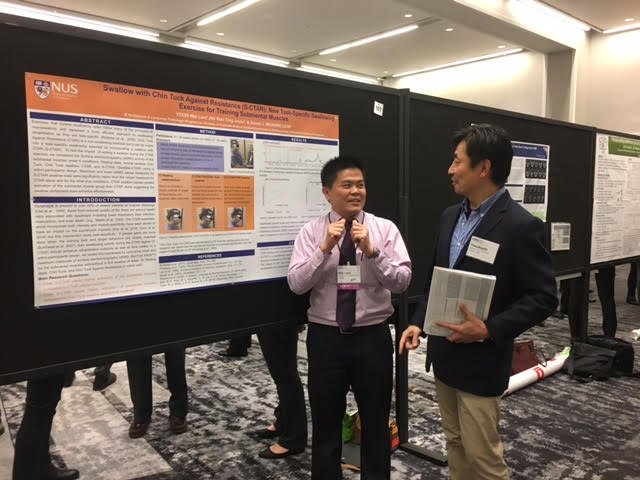
  • Swallow with CTAR (S-CTAR) Poster presented at DRS 2017 @ Portland, Oregon

    Swallow with CTAR (S-CTAR) Poster presented at DRS 2017 @ Portland, Oregon

    S-CTAR Poster

    Life has been so busy since I came back from DRS 2017. Finally, I have some time to put up this blog.

    I was honored to be invited to present a research poster at DRS this year.

    This is probably one of the best years for dysphagia research representation from Singapore as we have 2 oral presentations from Singapore General Hospital and 1 poster presentation (presented by me) from National University of Singapore.

    My poster presentation was on Swallow with Chin Tuck Against Resistance (S-CTAR). 

    Some of the happy moments at DRS:

    • Portland, Oregon is really beautiful and … cold. 
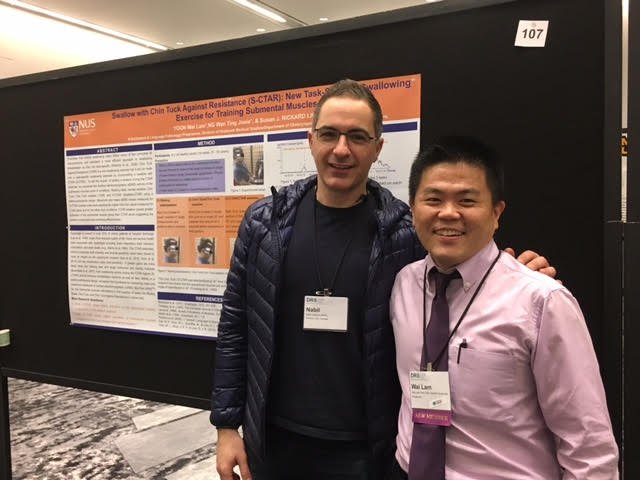
    • I finally got a chance to meet my Facebook pal, Nabil from Canada in person. We share a common interest in dysphagia. Lots of interesting discussion on dysphagia via WhatsApp and Facebook messenger. 
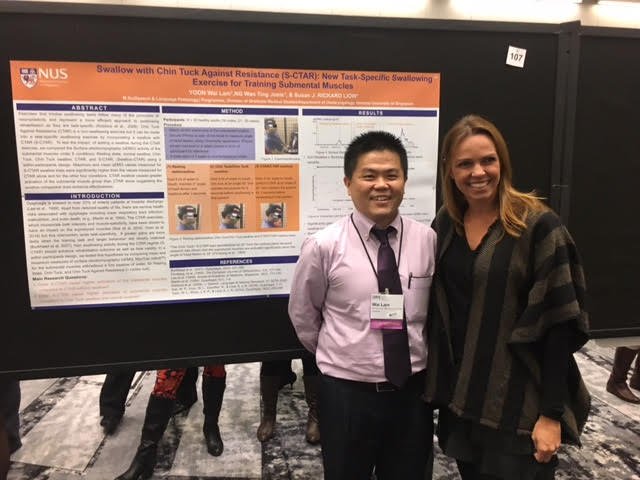
    • I got to meet some old friends and made more new friends from all around the world. 
    • I managed to take a selfie with Dr Reza Shaker!
    • Happy to know that CTAR or Chin Tuck Against Resistance is a well-known and well-liked exercise in USA and Brazil. Brazil Speech Pathologists informed me that they have started research on CTAR! I really hope that clinical study on CTAR will be out soon. 
    • Most Speech-Language Pathologists were excited to know that S-CTAR can be used as a task specific exercise and foresee that they will use it in their dysphagia therapy or management. 
    Portland Oregon
    Portland, Oregon
    Portland
    Portland, Oregon
  • With Dr Shaker
    with Dr Reza Shaker
    Nabil = my FB Pal
    My FB Pal, SLP from Canada – Nabil
    Kotomi - SLP from Japan
    Kotomi Sakai – SLP from Japan
    Brazil SLP
    SLP from Brazil
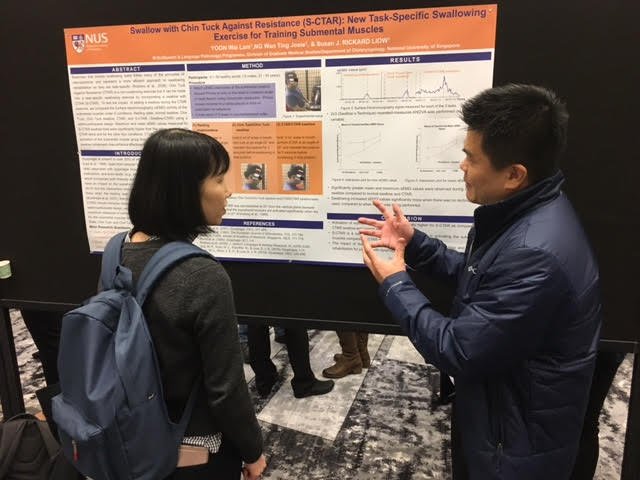
    Poster presentation
    Demonstrating CTAR to a dentist from Japan
    Demonstrating CTAR & S-CTAR
    Demonstrating CTAR and S-CTAR
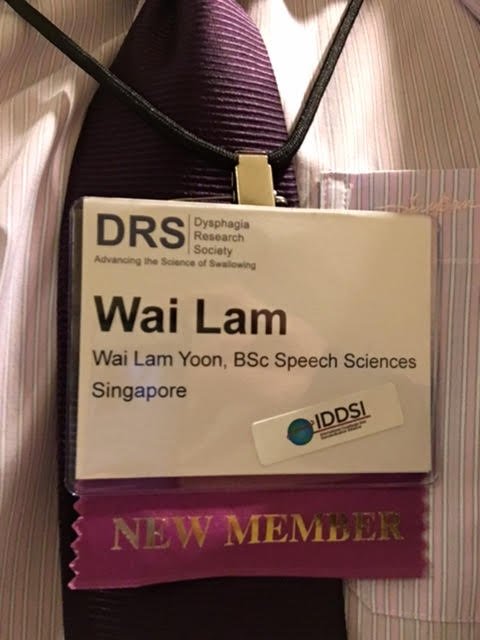
    I am a new DRS Member
    I am a new DRS member.
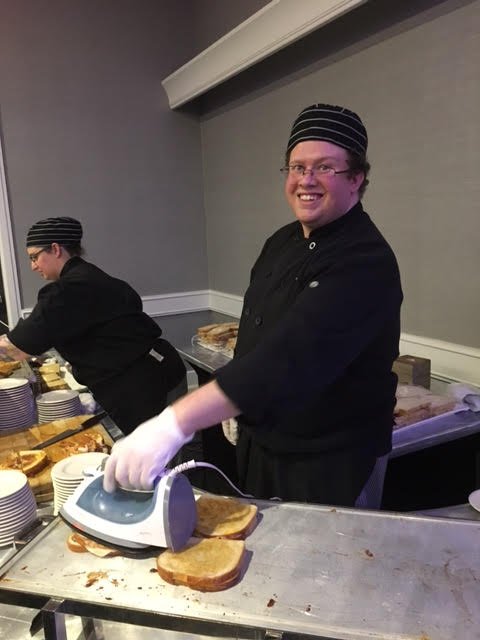
    Ironing sandwich
    This is new to me… Ironing sandwiches?!!!

    I was asked a few interesting questions on CTAR. One of the few interesting question is: are there any devices in the market that you think is good to be used to perform CTAR? I think this is an interesting question as we have seen quite a number of devices (different type of balls, hand held devices etc) being introduced to the market since the first paper on CTAR was published in 2014.

    Click  S-CTAR Poster to download the poster that I presented at DRS 2017.


    To end this post, I would like to congratulate and express my appreciation to all the DRS committees for this successful and enlightening meeting.