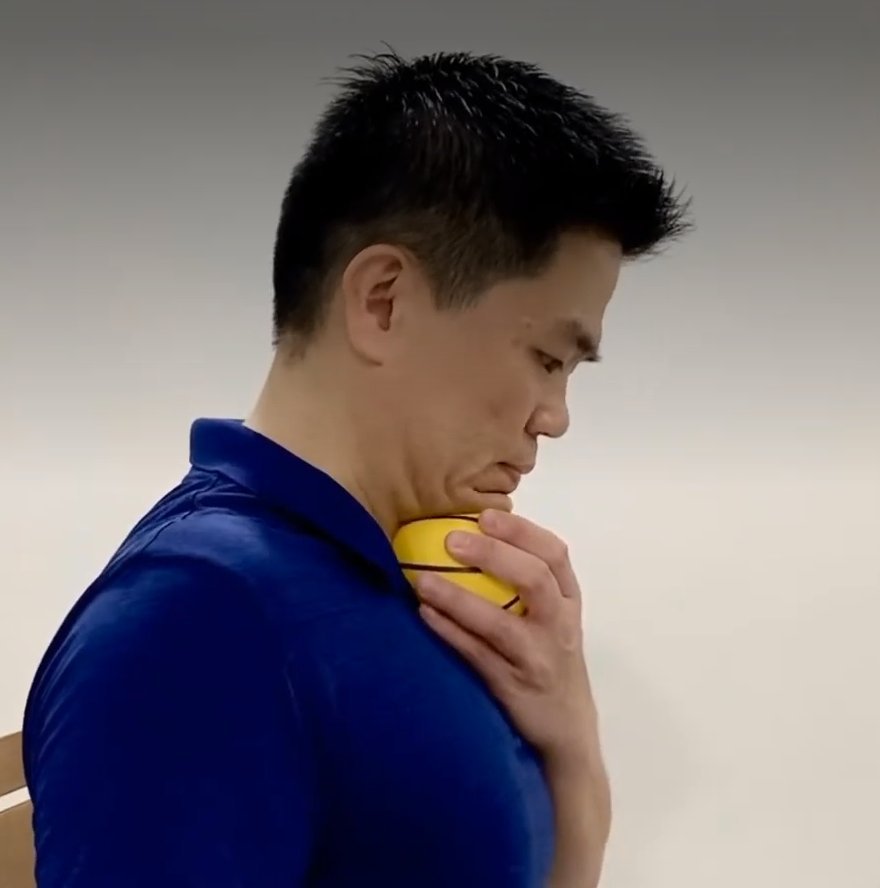
In short: Chin Tuck Against Resistance (CTAR) is a swallowing exercise that strengthens the suprahyoid muscles, the muscles under the chin that pull the hyoid bone up and forward during swallowing, which helps open the upper oesophageal sphincter so food and drink can pass into the food pipe. It is done sitting or standing, by tucking the chin down firmly against a small rubber ball. CTAR was developed by Singapore speech therapist Yoon Wai Lam and first published in the journal Dysphagia in 2014.
Why CTAR was developed
For many years, the Shaker (head-lift) exercise was the standard way to strengthen the suprahyoid muscles. It requires lying flat on the back and repeatedly lifting the head, which many people find tiring and hard on the neck. It is especially difficult for older adults, people who are frail or bedbound, and those who cannot lie flat.
CTAR was designed to train the same muscles in an upright position, using a simple rubber ball for resistance. This makes it practical to do at home, in a chair or at the bedside, with very little equipment.
How to do CTAR
You will need: a rubber ball about 12 cm in diameter for most adults. The right size depends on the length of your neck, so your speech therapist will advise. A ball pump can be used to adjust the firmness.
Part 1: Sustained CTAR (isometric)
- Sit or stand upright with your shoulders back. Keep this posture throughout.
- Hold the ball under your chin with one hand.
- Tuck your chin down against the ball as hard as you can, and hold for 60 seconds.
- Rest for 1 minute.
- Repeat for a total of 3 sets, twice a day.
Part 2: Repetitive CTAR (isokinetic)
- Keep the same upright posture, with the ball under your chin.
- Tuck your chin down hard against the ball, then lift your chin.
- Repeat 60 times, or as recommended by your speech therapist. Rest briefly if you need to.
What the research shows
- 2014, the original study (Yoon, Khoo & Rickard Liow, Dysphagia): In 40 healthy adults, surface EMG showed that CTAR activated the suprahyoid muscles significantly more than the Shaker exercise during the sustained (isometric) task, and at least as much during the repetitive (isokinetic) task. The study won First Place for Scientific Abstract at the 21st Annual Meeting of the Dysphagia Research Society, Seattle (2013).
- 2016, training effects (Sze, Yoon, Escoffier & Rickard Liow, Dysphagia): compared the training effects of CTAR and the Shaker exercise using surface EMG. In 39 healthy adults, CTAR targeted the suprahyoid muscles more specifically than the Shaker exercise and fatigued them equally or more, while the sternocleidomastoid (a large neck muscle) was significantly less activated and less fatigued. In other words, CTAR works the swallowing muscles hard while putting less strain on the neck.
- 2017, Swallow with CTAR (S-CTAR): combines a swallow with CTAR to make the exercise more task-specific to swallowing (Dysphagia Research Society, Portland).
- CTAR has since been studied and used by clinicians and researchers in many countries.
Who CTAR can help
After a swallowing assessment, CTAR may be included in therapy for adults with weak swallowing muscles, for example:
- Swallowing difficulties after a stroke, including brainstem stroke and lateral medullary syndrome
- Swallowing difficulties after head and neck cancer, including late effects of radiotherapy for nasopharyngeal cancer (NPC)
- Swallowing difficulties in Parkinson’s disease
- Reduced opening of the upper oesophageal sphincter, with food or drink left in the throat after swallowing
Safety: do it with professional guidance
CTAR should be prescribed after a proper swallowing assessment by a speech therapist, who will check that it suits your condition and set the right ball size, effort and number of repetitions. Stop and seek advice if you feel neck pain, dizziness or discomfort. If you have neck or spine problems, check with your doctor or therapist first. Exercises like CTAR are one part of swallowing therapy and do not replace advice on safe food and drink textures.
Frequently asked questions
What is the difference between CTAR and the Shaker exercise?
Both strengthen the suprahyoid muscles. The Shaker exercise is done lying flat and lifting the head, while CTAR is done sitting or standing by tucking the chin against a ball. Many people find CTAR easier to do and less tiring for the neck.
How often should I do CTAR?
A common programme is a 60-second hold repeated 3 times, plus 60 repetitive chin tucks, twice a day. Your speech therapist may adjust this to suit you.
What size ball should I use?
About 12 cm in diameter suits most adults, but the best size depends on the length of your neck. Your therapist will check the fit.
Can I do CTAR without seeing a speech therapist?
It is best to have a swallowing assessment first. Swallowing difficulties have many causes, and a therapist can tell you whether CTAR is right for you and how to do it safely.
Where can I find a CTAR video in my language?
The video above is also available in Mandarin, Malay, Korean, Japanese, Taiwanese Minnan and Bengali.
References
- Yoon, W.L., Khoo, J.K.P., & Rickard Liow, S.J. (2014). Chin Tuck Against Resistance (CTAR): New method for enhancing suprahyoid muscle activity using a Shaker-type exercise. Dysphagia, 29(2), 243–248. doi:10.1007/s00455-013-9502-9
- Sze, W.P., Yoon, W.L., Escoffier, N., & Rickard Liow, S.J. (2016). Evaluating the training effects of two swallowing rehabilitation therapies using surface electromyography: Chin Tuck Against Resistance (CTAR) exercise and the Shaker exercise. Dysphagia, 31(2), 195–205. doi:10.1007/s00455-015-9678-2
- Yoon, W.L., Ng, W.T., & Rickard Liow, S. (2017). Swallow with Chin Tuck Against Resistance (S-CTAR): New task-specific swallowing exercise for training submental muscles. Poster, 25th Annual Meeting of the Dysphagia Research Society, Portland, USA.
Written by Yoon Wai Lam, originator of CTAR, Director and Senior Principal Speech Therapist, B.Speech Sc. (Hons), in clinical practice since 2001. This article is for general information and does not replace an individual assessment. Contact us to arrange a swallowing assessment.
Leave a Reply