
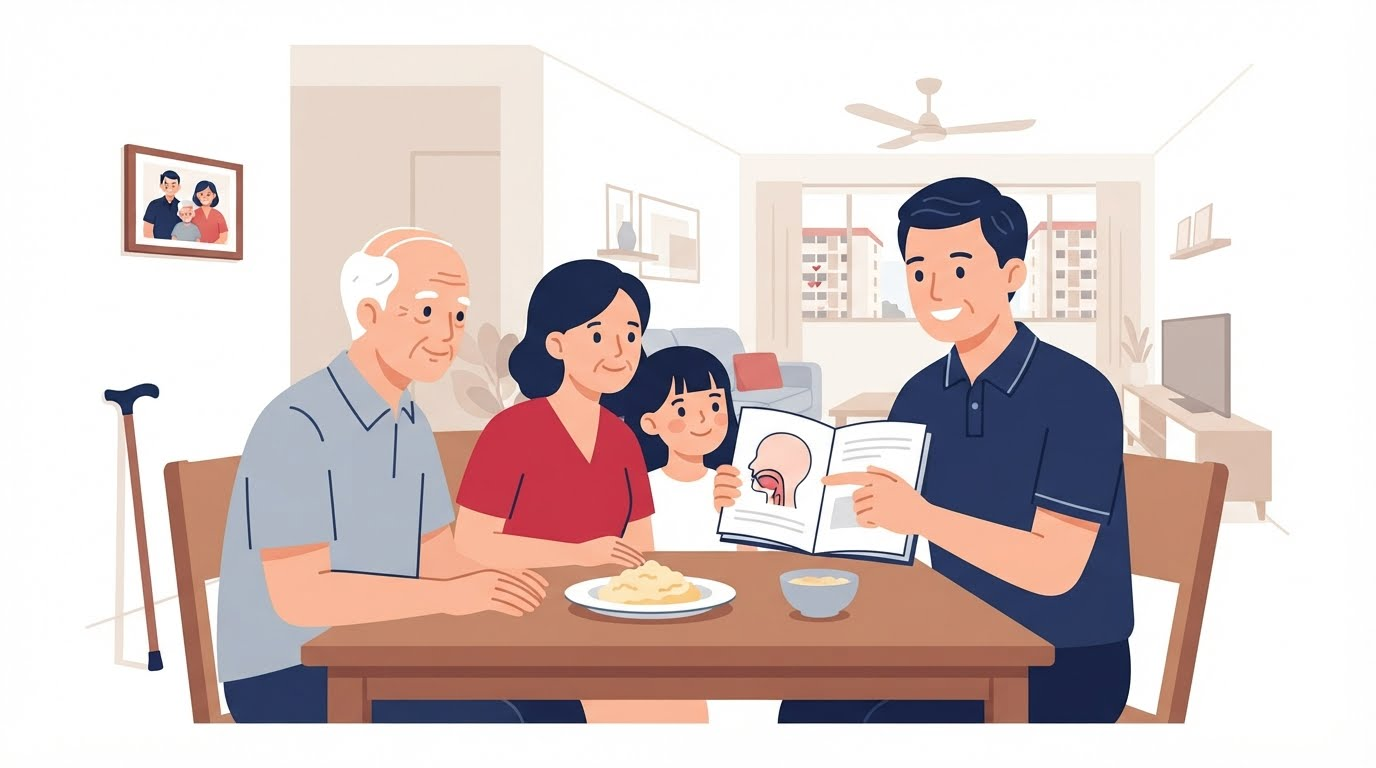
In short: Swallowing problems (dysphagia) are common in adults after a stroke, with Parkinson’s disease, dementia, cancer treatment or simply with ageing. They can lead to choking, chest infections and weight loss, but many people improve with the right assessment and therapy. This guide brings together all our articles in one place, so you can find what fits your situation.
This guide is for adults with swallowing difficulty, their families and carers, and nursing home teams in Singapore. Start with the section that matches your concern, then follow the links to the detailed guides.
1. What are swallowing problems, and how do I know?
Dysphagia means difficulty moving food, drink or saliva safely from the mouth to the stomach. Common signs include coughing or choking at meals, a wet or gurgly voice after drinking, meals taking much longer, food sticking in the throat, weight loss and repeated chest infections. Some people have no cough at all, which is called silent aspiration.
- Dysphagia (swallowing difficulties): what it is and what therapy can do
- 2-minute Swallowing Self-Check: a quick checklist to see whether an assessment may help
- Swallowing problems in elderly parents: signs of aspiration and what to do
2. Swallowing problems by condition
The cause of the swallowing difficulty shapes the therapy. Choose the condition that applies:
| Condition | Guide |
|---|---|
| Stroke | Speech and swallowing therapy at home after a stroke |
| Brainstem stroke | Swallowing after a brainstem stroke and case study: from PEG tube to full meals |
| Parkinson’s disease | Speech and swallowing therapy at home for Parkinson’s disease |
| Motor neurone disease (MND) | MND: speech and swallowing support at home |
| Dementia | Eating and swallowing in dementia: tips for families and carers |
| Ageing and muscle loss | Sarcopenic dysphagia: when muscle loss affects swallowing |
| Nasopharyngeal (NPC) and head and neck cancer | Swallowing after radiotherapy for NPC |
| Tracheostomy | Tracheostomy: speech and swallowing management |
| Palliative care | Comfortable eating, drinking and communication in palliative care |
| Long-standing or unexplained difficulty | Complex dysphagia management and second opinions |
3. Assessment and therapy
A swallowing assessment by a speech therapist finds out why swallowing is difficult and what is safe to eat and drink. Therapy then works on strength, coordination and safe eating, alongside the doctor and dietitian.
- Swallowing therapist and dysphagia treatment in Singapore: what assessment and therapy involve
- Instrumental swallow evaluation (FEES): a camera examination to see the swallow from inside
- CTAR (Chin Tuck Against Resistance): the swallowing exercise developed in Singapore, with free videos in seven languages
- Can my parent get off the feeding tube?: swallowing therapy for tube weaning
- Food thickeners for swallowing difficulties: when and how they are used
4. For families and carers
Most swallowing therapy can be done at home, where meals actually happen. These guides help families plan the next step:
- Adult and geriatric home speech therapy in Singapore
- Speech therapy at home for an elderly parent: what happens at the first visit
- How to choose a home speech therapist for an adult or elderly parent
Common questions
When should someone get a swallowing assessment?
If there is coughing or choking at meals, weight loss, repeated chest infections, or a new diagnosis such as a stroke, Parkinson’s disease or head and neck cancer. If in doubt, try the Swallowing Self-Check.
Do we need a doctor’s referral?
No. You can contact us directly. With your consent, we keep your doctor or care team updated.
Can swallowing problems get better?
Often, yes. Many people improve with therapy, especially after a stroke or with muscle weakness. In progressive conditions, therapy helps keep eating and drinking as safe and comfortable as possible.
Can therapy be done at home?
Yes. We provide home visits anywhere in Singapore, and online sessions are also available.
Written and clinically reviewed by Yoon Wai Lam, Senior Principal Speech Therapist. Last reviewed: November 2026.