In short: As we age, we slowly lose muscle all over the body. This is called sarcopenia. The muscles we use to chew and swallow can weaken too, which can lead to coughing at meals, choking and weight loss. This is called sarcopenic dysphagia. The good news is that swallowing muscles, like other muscles, can often be strengthened with the right exercises and good nutrition.
Most people know that older adults lose strength in their legs and grip. Fewer people realise that the tongue, the muscles under the chin and the throat muscles are also skeletal muscles. When muscle loss affects them, eating and drinking can become slower, harder and less safe.
What is sarcopenic dysphagia?
Sarcopenic dysphagia is swallowing difficulty caused by loss of muscle mass and strength, both in the body as a whole and in the swallowing muscles. It is diagnosed when other causes, such as a stroke, Parkinson’s disease or head and neck cancer, have been ruled out. The term was first used by researchers in Japan around 2012, and it is now recognised by swallowing specialists worldwide.
It matters because swallowing problems in older adults can lead to:
- food or drink going “down the wrong way” (aspiration), which can cause chest infections and pneumonia
- choking
- eating less, which leads to further weight and muscle loss
- dehydration
- less enjoyment of meals and social eating
This can become a cycle. Eating less means less protein and energy, which speeds up muscle loss, which makes swallowing harder still. Older adults who are frail, recently unwell, or have spent time in hospital or bed rest are most at risk.
What are the warning signs?
The early signs are easy to mistake for “just old age”. Watch for:
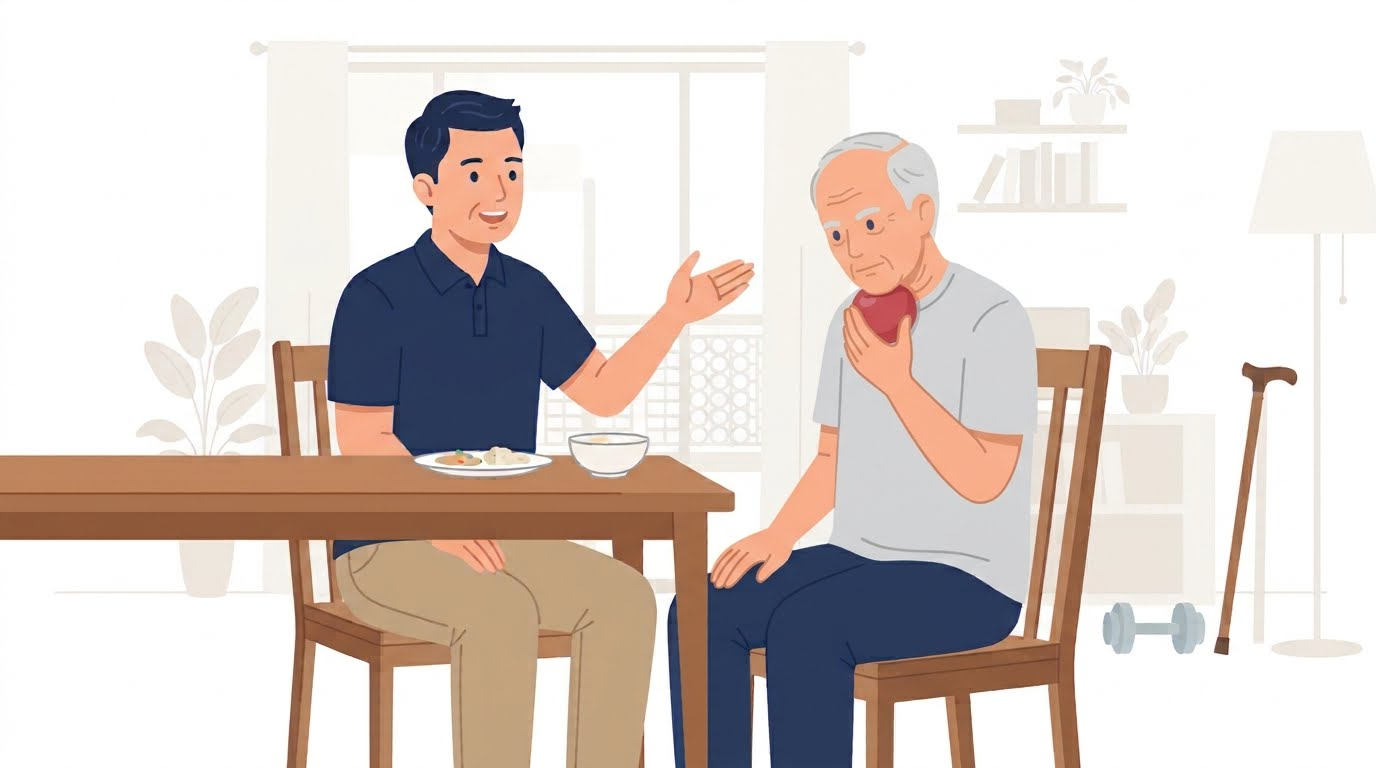
- coughing or throat clearing during or after meals or drinks
- meals taking much longer than before
- food left in the mouth or a feeling of food sticking in the throat
- a wet or gurgly voice after eating or drinking
- avoiding certain foods, such as meat, rice or bread, because they are hard to chew or swallow
- eating smaller portions, or unplanned weight loss
- repeated chest infections or fevers
- general weakness, such as slower walking, difficulty getting up from a chair or a weaker grip
If you notice several of these, try our 2-minute Swallowing Self-Check and speak to a doctor or speech therapist.
How is it assessed?
A speech therapist trained in swallowing (dysphagia) can assess this at home. A typical assessment includes:
- A history of eating, drinking, weight changes, chest infections and recent illness.
- A check of the mouth, tongue, lips and throat muscles: their strength, speed and coordination.
- Watching the person eat and drink different textures to see how safely and efficiently they swallow.
- Where needed, an instrumental examination such as FEES (a small camera to view the swallow) or a videofluoroscopy (a moving X-ray), to see what happens inside the throat.
Because sarcopenic dysphagia is linked to overall muscle loss, the speech therapist will also look at general strength and nutrition. With your consent, they work with the doctor, dietitian and physiotherapist.
What helps?
Research reviews recommend treating sarcopenic dysphagia from several sides at once: strengthening the swallowing muscles, improving nutrition and keeping the whole body active.
Swallowing strengthening exercises
Swallowing muscles respond to training like other muscles. Exercises are chosen to suit the person after assessment. They may include:
- CTAR (Chin Tuck Against Resistance). You sit upright and tuck your chin down to squeeze a soft rubber ball against your upper chest. It strengthens the muscles under the chin that lift the voice box and help open the top of the food pipe. CTAR was developed in Singapore and is now used worldwide. A 2025 review on managing sarcopenic dysphagia lists it among the exercises that can improve swallowing, and a 2025 randomised controlled trial studied it in older adults living at home with age-related swallowing difficulty. Because it is done sitting up, many older adults find it easier than older exercises done lying flat. See how to do CTAR, with free videos in seven languages.
- Tongue strengthening exercises, such as pressing the tongue firmly against the roof of the mouth.
- Jaw-opening and other resistance exercises for the muscles that open the food pipe.
- Breathing muscle training, which can help with a stronger cough to clear the throat.
Nutrition
Muscles cannot rebuild without enough protein and energy. A dietitian can suggest ways to add protein, and the speech therapist can advise on food and drink textures that are safe and easy to manage. Texture changes should be based on an assessment, as unnecessarily soft or thickened diets can reduce how much a person eats. See our guide on food thickeners for the elderly.
Staying active
General exercise, such as walking, standing up from a chair and light strength training, helps rebuild muscle across the body. A physiotherapist can suggest a safe programme.
Do not try exercises without checking first
The right exercise depends on the cause of the swallowing difficulty. Some exercises are not suitable for people with neck problems or certain heart conditions. Please check with a speech therapist before starting.
Common questions
Is swallowing difficulty a normal part of ageing?
Some slowing of swallowing is common with age, but coughing, choking, weight loss and chest infections are not normal and should be checked. Many causes, including sarcopenic dysphagia, can be helped.
Can weak swallowing muscles get stronger?
Often, yes. Swallowing muscles can respond to strengthening exercises, especially when combined with good nutrition and general activity. Progress depends on the person’s overall health, so a speech therapist sets and adjusts the programme.
How is sarcopenic dysphagia different from dysphagia after a stroke?
After a stroke, swallowing problems come from damage to the brain’s control of swallowing. In sarcopenic dysphagia, the main problem is weak and reduced muscle. The two can also occur together, and both can be assessed by a speech therapist.
Do we need a doctor’s referral?
No. You can contact us directly. With your consent, we keep your doctor or care team updated.
Can assessment and therapy be done at home?
Yes. We provide home speech therapy anywhere in Singapore, and online sessions are also available.
References
- Sakai K, Sakuma K. Sarcopenic Dysphagia as a New Concept. In: Frailty and Sarcopenia: Onset, Development and Clinical Challenges. InTech; 2017. doi:10.5772/intechopen.68791
- The Management of Sarcopenic Dysphagia: A Multidisciplinary Approach Leveraging Emerging Technologies. Aging and Disease. 2025;16(5):2752–2769.
- Possible Rehabilitation Procedures to Treat Sarcopenic Dysphagia. Nutrients. 2022;14(4):778.
- Effect of progressive chin tuck against resistance exercise on community-dwelling older adults with age-related dysphagia: a randomized controlled trial. European Geriatric Medicine. 2025;16(4):1481–1492.
- Chin Tuck Against Resistance Exercise With Feedback to Improve Swallowing, Eating, and Drinking in Frail Older People Admitted to Hospital With Pneumonia (CTAR-SwiFt). JMIR Formative Research. 2026.
- Yoon WL, Khoo JKP, Rickard Liow SJ. Chin tuck against resistance (CTAR): new method for enhancing suprahyoid muscle activity using a Shaker-type exercise. Dysphagia. 2014;29(2):243–248.
Written and clinically reviewed by Yoon Wai Lam, Senior Principal Speech Therapist. Last reviewed: November 2026. This article is general information, not a substitute for an individual assessment.